Consider the Previous Problem Again and Explain Why the 4th Stage Uses a Pnp Transistor.
Microsoft founder Bill Gates doesn't understand why people are not concerned about artificial intelligence (AI), agreeing with Elon Musk that it could be one of our biggest existential threats. Microsoft'southward research head Eric Horvitz disagrees. Concern over the social and economical impacts of AI is 1 of the many controversies surrounding emerging technologies.
There are many reasons for this opposition to new technologies. In my new book, Innovation and Its Enemies: Why People Resist New Technologies, I argue that our sense of what it means to be human lies at the root of some of the skepticism virtually technological innovation.
The book was launched on 6 July at the 16th Conference of the International Schumpeter Club in Montreal. Given Schumpeter's comments on innovators and entrepreneurs – he once said that their piece of work opened them upwards to "social ostracism and to physical prevention or to straight assail" – there could non accept been a more suitable venue. Schumpeter wrote this annotate in 1912. Which is to say that we take a long history of resisting technological advances. And it's to history we must turn to sympathize why this is so.
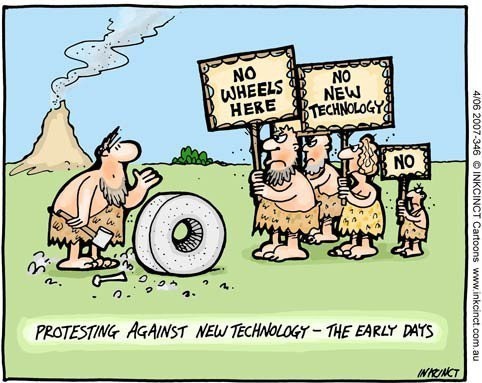
Prototype: INKCINCT cartoons
Looking in the past for answers
The book draws from 600 years of technological controversies ranging from attacks on coffee in Medieval Eye East and Europe to today's debates on the potential bear upon of AI, drones, three-D printing, and gene editing.
It argues that society tends to reject new technologies when they substitute for, rather than augment, our humanity. Our desire to humanize engineering is captured in the sense of humor of this Bradley's Bromide: "If computers get also powerful, we can organize them into a commission – that will practice them in."
We eagerly embrace them when they support our desire for inclusion, purpose, challenge, meaning and alignment with nature. We do so even when they are unwieldy, expensive, fourth dimension-consuming to use, and constantly break down.
For example, the early days of the introduction of tractors in the United states were hardly the paragon of farm efficiency. Tractors offered niggling advantage over horses. Some opponents argued that their value could be marginally improved if they could reproduce themselves similar horses.
What 'brick phones' teach u.s. about new technologies
Equally technologies migrate across countries and continents, their societal implications as well change. For example, when Motorola introduced cellphones in the United States in 1983, they were dismissed as toys for the rich. They toll $4,000 (today'south equivalent of $10,000), weighed ii pounds, stood at a human foot tall, took 10 hours to accuse, and delivered only xxx minutes of talk time.
These metrics would take qualified them as a tool for updating one'due south Facebook status. They were the butt of jokes, dubbed "brick phones" considering of their shape and weight.
The first model was called DyanTAC, standing for Dynamic Adaptive Total Surface area Coverage. Despite this aggressive and prospective name, the early models did footling to augment our humanity, especially for young people. Adoption rates in the United states of america were glacial, putting information technology well behind Europe, Asia and Africa.
When cellphones hit Africa, they were reinvented past engineers and diffused using novel concern models created by entrepreneurs in Kenya, who pioneered mobile money transfer – called "transfer" instead of "banking" because banks wouldn't let the telecoms agree money.

Today cellphones are no longer just a communication tool. They are serving equally banks, schools, clinics, and vehicles for spreading transparency and democracy. They augment our humanity in ways that could not take been anticipated in the early 1980s. They are also serving equally a part model for improvements in other sectors such every bit off-grid electricity supply.
And at present nosotros have more than just cellphones. Nosotros alive in exciting times where technological multifariousness and creativity offer limitless opportunities to expand the human potential for all, not simply for certain exclusive sections of order.
When technologies 'requite back'
Innovation and Its Enemies shows that resistance to new technologies is heightened when the public perceives that the benefits of new technologies will merely accumulate to a pocket-size section of society, while the risks are probable to be widespread. This is why technologies promoted by large corporations oft face potent opposition from the public.
Similarly, new technologies face great opposition when the public perceives that the risks are likely to be felt in the curt run and the benefits volition simply accumulate in the long run. So telling a skeptical public that new technologies will benefit future generations does not protect us from the wrath of current ones.
What is the way forward? The answer might lie in the much-abused phrase "social entrepreneurship". For many, this term is a euphemism for a charity or nongovernmental arrangement. Merely what is actually needed is to bring the "social" back into "entrepreneurship".
This means exploring new ways by which enterprises tin can be seen as contributing to the common good. The fact that enterprises use new technologies to enhance their competitiveness makes it difficult for the general public to separate engineering science from its uses – for better or for worse.
The fate of new technologies will continue to be determined by the residuum of power in order. For about 400 years, Ottoman rulers opposed the printing of the Koran. Doing so would have undermined the role of religious leaders equally sources of cultural codes. But when the printed give-and-take seemed to reinforce the ability of the rulers they slowly went confronting previous fatwas banning the press of the Koran.
Innovation and Its Enemies provides many other examples where the acceptable of new technologies is dependent on whether they reinforce rather than undermine incumbent practices. The dilemma facing modern society is whether reinforcing existing practices undermines gild.
New technologies are essential to fostering economic growth, meeting human needs, and protecting the surroundings. New clean free energy technologies such as solar photovoltaic cells and air current turbines, for example, are critical to reducing carbon dioxide emission and addressing the challenges of climate change.

Image: Earth Policy Institute/Bloomberg
But their adoption is ofttimes held back by the incumbent industries and vested interests. The dilemma is that in many cases clinging to the old may in fact be in conflict with our humanity, especially in regard to our search for affinity with nature. Equally the American composer John Cage aptly put information technology: "I tin't understand why people are frightened of new ideas. I'thousand frightened of the old ones."
bissetteorameffees.blogspot.com
Source: https://www.weforum.org/agenda/2016/07/why-do-people-resist-new-technologies-history-has-answer/
0 Response to "Consider the Previous Problem Again and Explain Why the 4th Stage Uses a Pnp Transistor."
Post a Comment